
This page provides links to our free software packages. Currently, the available packages are JSEISMIC and JBDD. Some background on JSEISMIC is provided below, followed by sections that provide the download links for the available packages.
Introduction to JSEISMIC code
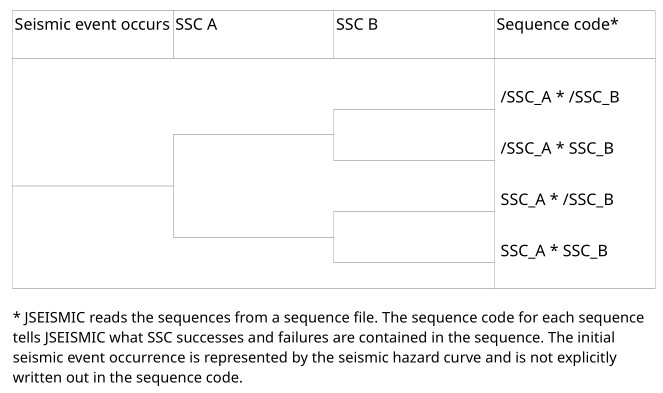
The figure shows an event tree which delineates the possible combinations of SSC successes and failures following a seismic hazard event. Such an event tree can be called a Seismic Damage State (SDS) tree - this is similar to a Seismic Initiating Event Tree (SIET). Historically, a SDS would include the status of all seismically impacted SSCs that need to be modelled in the Seismic PSA, this being a subtle difference compared to the SIET approach in which are also seismically affected SCCs in the remaining PSA fault tree models. Experience has shown that JSEISMIC can support both the SDS approach and the SIET approach.
The rationale for using a SDS is that it allows inclusion of SSC successes as well as failures and also, by supporting an quantification approach external to the PSA event trees and fault trees, allows the calculation of SDS (event tree endpoint) frequencies that account for the correlating effect on the failure and success combinations that arises due to the wide range of potential hazard magnitudes modelled by the hazard curve.
The particular tree shown here delineates all possible combination of success/failure of item A and item B - but in other examples the trees may be simplified with some combinations removed. (This occurs for example when the failure of one SSC leads to a bounding consequence, implying that the state of subsequent SSCs is then less important.
To model this example with JSEISMIC, two files are created: (1) the main input file, which uses an ini format, and (2) a file with a listing of the sequences to quantify. Example contents for these files are shown below.
example_1.jin (main JSEISMIC input file)
samples=0
[hazard]
acceleration_points=0.05,0.2,0.4,0.8,1.6,3.2,3.3,3.35,3.4
exceed_frequencies=2.2E-02,4.5E-04,6.5E-05,9.3E-06,1.3E-06,1.9E-07,1.8E-07,1.7E-07,1.6E-07
acceleration_upper_limit=3.8
[fragilities]
SSC_A=0.9 0.32 0.35
SSC_B=0.75 0.32 0.4
[seq files]
file1=example_1-sequences.seq
SDS002 = /SSC_A*SSC_B.
SDS003 = SSC_A*/SSC_B.
SDS004 = SSC_A*SSC_B.
SDS002 5.129E-05
SDS003 1.524E-05
SDS004 1.076E-05
JSEISMIC open source - latest
JSEISMIC takes input files in an inifile format, which allows specifying a seismic hazard curve as a list of acceleration points and corresponding exceedance frequences, then also specifying a list of seismically affected components and their median capacities as well as beta (distribution width parameters). The input ini file also contains the names of sequence files to quantify - these consist of a listing for each sequence of components that fail seismically or do not fail. The purpose of the program is to calculate the frequency of each of the sequences listed, taking account of the hazard curve and the component successes and failures in each case, as calculated from the median and beta values given in the inifile.
jseismic-src-2022-04-30.tar.gzJSEISMIC open source - sha256 sum for verification
Text file containing sha 256 checksum for verifying the tar.gz file. Command line: sha256sum -c jseismic-src-2022-04-30_sha256.txt (on windows you will need to install sha256sum)
jseismic-src-2022-04-30_sha256.txtJBDD open source - latest
Jacobsen BDD tools allow accurate quantification of cutset lists using the Open Source CUDD package. We provide a GUI frontend, a driver script (run from the GUI) and an example conversion script which converts an excel format of cutsets to the standardized JSON format that the driver script takes as input to define the cutsets.
JBDD-2022-04-26.zipJBDD open source - sha256sum for verification
Text file containing sha 256 checksum for verifying the zip file. Command line: sha256sum -c JBDD-2022-04-26_sha256.txt (on windows you will need to install sha256sum)
JBDD-2022-04-26_sha256.txt